Tone deaf test
Higher or lower? See how small a step you can hear.
How it works
- Press Start. The page only plays the piano, so it never asks for the microphone.
- Listen to both notes, then choose Lower or Higher. Hear it again plays the pair once more.
- Three right answers take you to a smaller step. Two wrong ones at the same step end this part.
- Then come four pairs of short melodies. Say whether each pair was the same, or whether one note changed.
- Headphones or a quiet room help with the smallest steps.
In the app
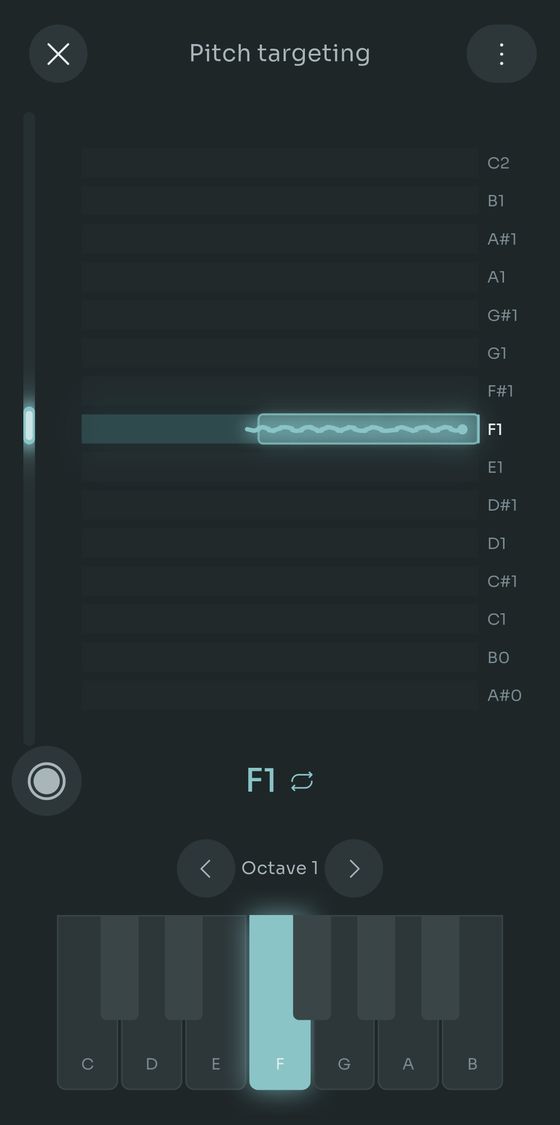
FreeHearing a note is the first half, and singing it is the second. Scalita's Pitch targeting and Listen & Repeat work on both: match notes on a live pitch trail, or sing back leaps from songs, in your own range. Free on Android, no account.
Reference
About the test
Reviewed
Two piano notes play and you say whether the second one went up or down. Each step you hear makes the next one smaller, from a semitone down to 3 cents. Four short melodies close the test, and the result is the smallest step you heard.
What the test measures
Pitch differences are measured in cents. A semitone, the step from one piano key to the next, is 100 cents. The test plays two notes and asks which way the second one moved. It starts with a whole semitone, then halves the step each time you hear it: 50 cents, 25, 12, 6 and finally 3.
Each step gets up to three pairs. Two right answers count it as heard and move you on. Two wrong answers at the same step end that part, and the last step you heard is your result. The melodies come next: two five-note tunes, played one after the other, either the same or with one note moved a semitone out of the key.
What a result looks like
- Smallest step you heard: 12 cents
- Steps heard: 4 of 6
- Melodies told apart: 4 of 4
12 cents is about an eighth of a semitone. When you sing a note, the Scalita app counts it as in tune within 10 cents and as close within 25.
What tone deafness is
The condition people mean by tone deaf is called congenital amusia, a lifelong difficulty with hearing pitch in music. A study of 20,000 people put it at about 1.5 percent of the population (Peretz and Vuvan, 2017). In Hyde and Peretz's experiments (2004), adults with amusia had trouble hearing a note move up or down by amounts the other adults heard easily, and practice didn't help them, while they heard changes in timing as well as anyone.
Researchers screen for it with longer tests, such as the Montreal Battery of Evaluation of Amusia, whose melody tests ask whether two tunes are the same or different. The melody part here borrows that shape, in four pairs instead of dozens.
Hearing and singing are different skills
Most people who sing off pitch hear pitch normally. In Pfordresher and Brown's experiments (2007), 10 to 15 percent of the participants sang notes back at least a semitone off, and they told pitches apart as well as the accurate singers did. For most people, the hard part is steering the voice onto a note they can already hear.
So if the steps here went well, singing in tune is a separate thing to measure. The sing-in-tune test plays a note and shows how close you sing it back, and how to sing in tune has the first exercises to practice it.
Ears get finer with practice
Telling small steps apart is a skill, not a fixed trait. Practice helps many people tell notes apart more finely, which is not the same as singing them.
What this test doesn't tell you
It's a quick listening check with piano notes, not a hearing test and not a diagnosis. A result is one reading on one day, through one set of speakers or headphones, and guessing gets half of all answers right, so luck plays a part. It can't tell you whether you have congenital amusia: researchers use longer test batteries and a full assessment for that. It also says nothing about your voice. Hearing a step and singing it are separate skills, and the sing-in-tune test measures the second one.
If you hear nothing
Turn the volume up and press Start again. On a phone, check that the sound isn't going to a Bluetooth speaker or earbuds you forgot about. If the piano doesn't load, the page says so: check your connection and try again.
Common questions
Am I tone deaf?
Probably not. Congenital amusia, a lifelong difficulty with pitch, affects about 1.5 percent of people. Most people who think they're tone deaf hear pitch normally and find it hard to sing a note they can hear. This test shows how small a step you hear. The sing-in-tune test shows how close you sing.
What result should I expect?
There's no pass mark. As a reference point, the Scalita app counts a sung note as in tune within 10 cents and as close within 25, and in Micheyl and colleagues' study trained musicians heard far smaller differences than non-musicians did before practice.
Why did I get a different result this time?
Each answer is higher or lower, so a guess is right half the time, and a lucky or unlucky guess can move the result by a step. Tiredness, a noisy room and small speakers matter too. Take the test a few times and look at where it usually lands.
Do I need headphones?
No. Any speaker you can hear clearly works, and headphones help most with the 6 and 3 cent steps. The test never uses the microphone.
Can I train my ear?
Yes. Practice helps many people hear smaller steps. That is not the same as singing them, and singing helps as well: matching notes trains you to listen for where your voice is against the note.
Sources
- Peretz and Vuvan (2017), Prevalence of congenital amusia, European Journal of Human Genetics 25(5)
- Hyde and Peretz (2004), Brains that are out of tune but in time, Psychological Science 15(5)
- Peretz, Champod and Hyde (2003), Varieties of musical disorders: the Montreal Battery of Evaluation of Amusia, Annals of the New York Academy of Sciences 999
- Pfordresher and Brown (2007), a study of poor-pitch singing and pitch perception, Music Perception 25(2)
- Micheyl, Delhommeau, Perrot and Oxenham (2006), Influence of musical and psychoacoustical training on pitch discrimination, Hearing Research 219